An accumulation of railway memories has prompted this new page covering
recollections of the Southern Railway from Waterloo to Southampton, Bournemouth,
Weymouth and Exeter via Farnborough Main station. I’m not certain it was called
Farnborough Main in the 1950s, it may have been just Farnborough and Farnborough
North, the latter station being on the Guildford to Reading line a mile to the East.
My first recollection of the Southern Region of British Railways dates from 1949 when a family holiday saw us on a late
night train from Waterloo to Bude. It may have been The Atlantic Coast Express
but the month was June and it was dark when we left London so maybe it was just
an ordinary overnight service. It went to Exeter where it split and individual coaches
were taken to various holiday destinations in time for breakfast.
Later the same year the family moved
from East London to the Minley Estate in Cove with
Farnborough being the nearest railway station. With extended family in London we
quite often took the train into town and I recall the adult return fare was six
shillings and eight pence in Third Class. (33p.) I remember because I was trying
to work out as a young lad if rail fares were a penny a mile as I read somewhere that they were.
At Cove Junior school I sat next to Denley Cole who introduced me to train
spotting. He had a massive Hornby ‘O’ Gauge clockwork train set at home which
totally filled the main living room with track branching everywhere.
I was never in Denley’s league when it came to railway engine knowledge. I could tell a Bulleid Pacific from a Q1 class but Denley instinctively knew a School
Class locomotive from a Nelson or King Arthur. (I am expecting my memory
for names to be corrected here.)
Our usual spotting site was the low bridge at West Heath (since rebuilt) because
the penny Platform Ticket at Farnborough was beyond our means, We were
nevertheless to be occasionally found in Guildford or Reading - watching the slip coaches -
and on one occasion London Victoria. These were by-products of parental shopping trips.
Farnborough North was only a bike ride away and what we called the Birkenhead
Express (steam hauled) went through daily. Running from Sandwich in Kent to Birkenhead it would sometimes have 14 carriages.
Guildford had its own little shunting engine (name long forgotten, was it
Ironside?) and Farnborough had Invincible which went from the
sidings at Farnborough through local streets to the Royal Aircraft Establishment. Its name has been given to a road which now covers part of the track.
Where did the Ian Allen collector's books and badges go?
My train spotting activities ceased in November 1958 when my family moved
from Cove
to Church Crookham but in August 1961 resumed in a different form with a job in London,
Chancery Lane. A quarterly season ticket from Fleet was £19 but probably a discounted rate
for under-18s. I recall being annoyed because no one told me that and I could have bought an annual ticket
and saved a lot of money.
Before long a little gang of ex-F.G.S. boys would travel to Waterloo together.
Lindsey Pratt, Ian Bonham, Michael Clegg and Barry James. There was another who
may not have been former F.G.S. who would quite often sneak a ride in the
driver’s cab. Only on the return trip obviously because he would alight at
Farnborough somewhat smut ridden. I regret not doing the same.
On the return trip we would sometimes be joined by former
High School girls.
Names long forgotten but one a Gillian and the other with the surname of Wood I think!
(It's come back to me, Gillian Rundle who lived in Fleet.)
Lin and I worked in the same building and the office day ended at 16:50. If we were
lucky, and usually we were, we could just catch the 17:09 on Waterloo’s Platform 9 which was a Woking,
Farnborough, Fleet and all stations to Exeter service.
At Woking, the station announcer would run through all the stopping places and at
the time I could recite every station name from Woking to Exeter. A later
service missed Woking and would get to Fleet in 39 minutes, quicker than modern electrics.
A few incidents stick in my memory. During the particularly bad Winter of 1962
engines would belt down the fast track at Fleet showering all the waiting
passengers with snow. Occasionally when the morning journey was disrupted the
train might stop at Wimbledon and the Bulleid Pacific would slip and slide over
the adjacent flyover.
The Station Master at Fleet lived on the premises and before the days of
announcements one could knock on his door and ask him when the next train might
deign to come.
When Clapham Junction had a problem the train home would head off towards
Wandsworth and negotiate an impossibly steep and tight turn on to the District
Line which ran over the top. This always attracted local sightsee-ers enjoying
the sight of steam over the generally electric railway. The main line was rejoined at Wimbledon.
Home bound trains were generally helped out of Waterloo with a banking engine.
If the lead engine stopped for whatever reason and the banker wasn’t looking
where he was going there would be one Hell of a bang.
Not far out of Waterloo was the filthy engine works at Nine Elms. I feel sure
that occasionally one could see an inverted engine having the clinker shaken out of its fire box but maybe my memory is playing tricks.
In July 1967 the line was electrified up to the Brookwood junction
which was already electrified for the Alton service. Service was
disrupted as track was deep excavated and relaid. The first month of electric
service was total chaos but things soon settled down.
Wow, I didn’t realise I had so many railway memories stored away. Now I must hand over to some real experts.
Malcolm Knight : March 2026
Paul Cooper : F.G.S. 1961-1968
Paul was a few years younger than me
and I didn’t know him which is a shame. I was always interested in photography
but my equipment was primitive compared to his.
He put it to very good use on the railway using not only a single lens reflex Petriflex but also a dual lens Rollieflex, the weapon of choice in those days for
every wedding photographer.
My second hand camera with a fixed 45mm lens could simply not compete. The truth
is that I took pictures of aeroplanes but it never occurred to me to photograph trains.
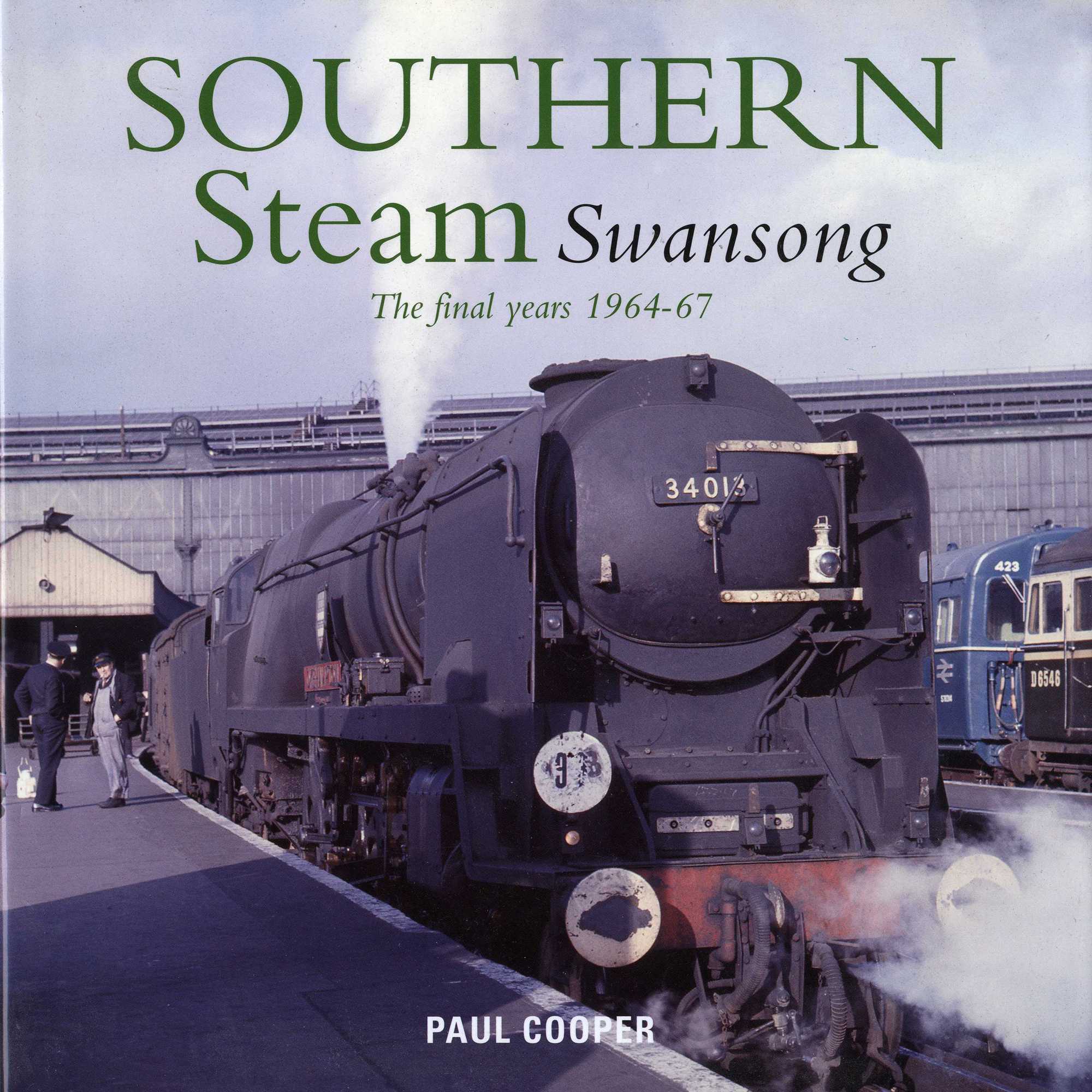
As the image indicates, Paul published his collection of railway photographs and
I think it is superb for anyone with the slightest interest in railways. This is what he said to me at in 2018…
Below is the link to the publisher. Amazing to think that I did all
this (i.e. took the pictures) before I entered Upper Sixth. It has certainly taken up a
few months post retirement though I have only just fully given up work at the
end of January – a 7+ year run out of consultancy work that finished with me
negotiating deals in China, Vietnam and Thailand.
Would you believe that I learnt my negotiating skills under one David Davis M.P.? I worked with him for many
years (in fact I replaced him when I first joined Tate & Lyle) and he is a
superb, tough negotiator. So not sure if current press criticism is justified
but who knows – Brexit is so complex – and we haven’t seen each other for a couple of years).
As an aside, I was in Farnborough last week. My father was being interviewed by
FAST and recorded on video regarding his days at the R.A.E. that ranged from 1936-52 for
their archive. He was also interviewed by Paul Beaver just before Xmas on his
work with Eric Winkle Brown (Paul is his biographer) – Winkle Brown was Dad’s
test pilot in the war when he was designing catapault launchers/arrester gear
for carriers. All the testing was done on land first before they hightailed up
to Scotland for carrier trials.
Quite remarkable. When Dad launched his book at
the SBAC in 2008 he had Winkle Brown co-signing copies and we all met up again
for the Cody Statue unveiling in 2013. He’s 98 in 3 weeks and has grey matter to die for!
Sorry, didn’t mean to labour on but so many connections in life….
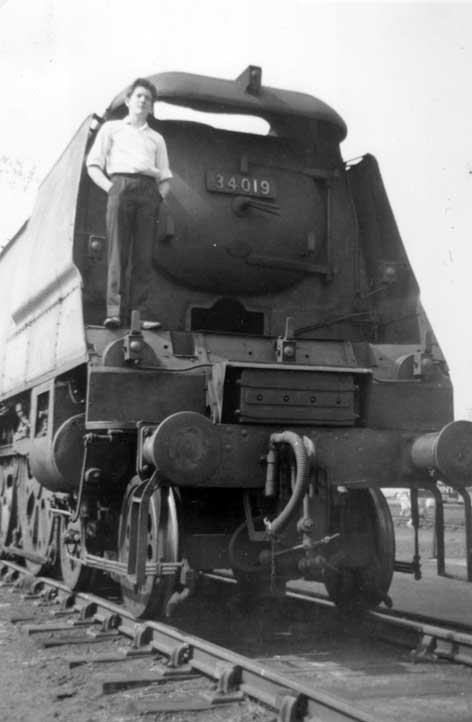
Ray transferred his interest in railway engines to aeroplanes and became an airline pilot but here
he is in Eastleigh in 1964 trampling over a couple of locomotives.
Peter Hews : F.G.S. 1963-1969
My other passion was all things Steam Trains. Most of my friends were into
aircraft and aircraft spotting so the trains were a solitary sideline. Neither
of my kids were interested in trains either but my oldest son is a Captain for
Air Canada on 737 Max series.
Whilst you [Malcolm Knight] were commuting, I was finishing ‘O’ Levels in 1967.
There was a week or two between when others were taking exams and we had to
return to F.G.S. for a useless, no man’s land period before the summer holidays started.
I bought a student’s Southern rail pass for a week for £2·50 (actually £2 and 10
shillings as Britain hadn’t yet decimalized the currency) and planned to travel
between Exeter, Weymouth and Dover. I had not realized that express passenger
steam was about to end so found myself each day between Waterloo and Weymouth.
There was no discernible pattern to the steam workings but I managed at least
one trip a day behind a Bulleid pacific. One memorable trip was the
mid-afternoon express from Weymouth to Waterloo. A massive uphill climb to the
summit tunnel between Weymouth and Dorchester South and a 96 m.p.h. speed between Winchfield and Farnborough behind West Country Class. 34021 Dartmoor. Magic!
Although not from F.G.S, there’s a great book by Alan J. Goodwin - Southern Steam January - July 1967. Countdown to Extinction.
Western Canada, where I live, is an almost steam desert in comparison to the UK.
The summer between F.G.S. and College found a friend from Yateley and myself
volunteering for a week on the Bluebell Railway in Sussex. Sadly the job was
replacing sleepers on the line but we did get a cab ride to the site each
morning, a cab ride back, free meals and free camping. I could’ve stayed there
way longer but College was next on my list of priorities. A missed opportunity
perhaps but no pay cheque.
Back in Farnborough, across the road from the school was the house in which
Smith the physics teacher lived but once owned by the founder of the 10¼" gauge
railway that ran from Farnborough Green to Yorktown near Camberley - the
Camberley and Surrey Border Railway ran from about 1938 until the start of WW2.
Apparently some of the route is still visible on the ground and on Google Earth.
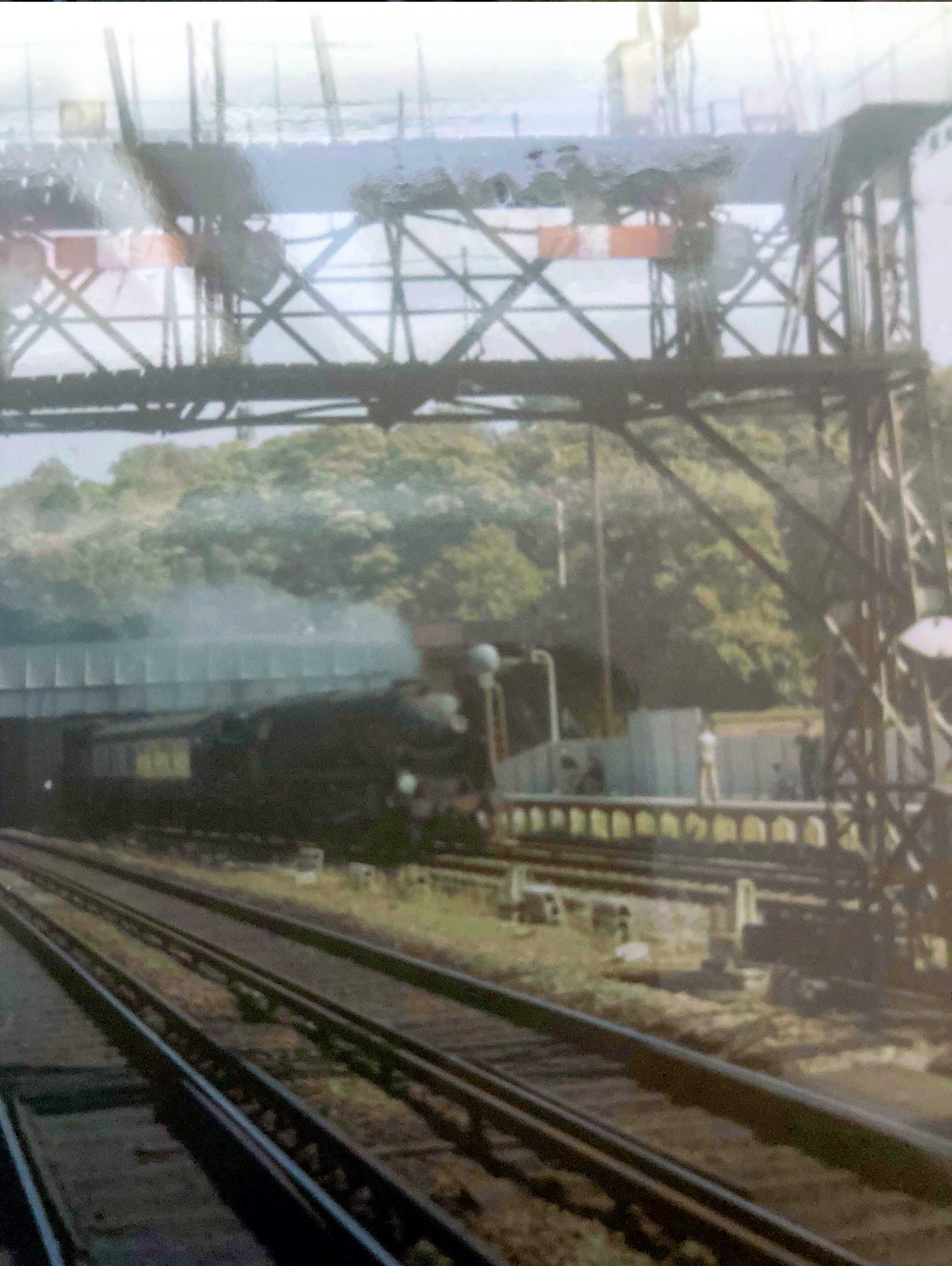
Photo taken at Farnborough just two weeks before the last steam services.
Bruce Main-Smith - F.G.S : 1936-1942
You asked me about the miniature railway. This was about 12 inch gauge and
serious stuff. It ran a timetable service to Blackwater (9d return) that was
used as a good place for housewives to shop as there was almost nothing in North
Farnborough.
At first it originated at Attwood’s Dairy which was (then) an unmade road
alongside the school on F.G.S.’s western edge; I think the road led to a gravel
pit of which there were lots in the area across to Hawley. There were two
flooded pits between Leopold and Prospect Avenues and on which some of us F.G.S.
boys floated a ramshackle raft made from empty oil drums and bits of wood,
highly dangerous and I could not (then) swim. These pits have been filled in and
houses built thereon.
The Farnborough terminus of the railway was later relocated to a triangle of
land between the two full size lines and on the west side of the main road from
Bradford’s Garage to The White Hart. It closed for some reason not known to me
and that extensive site became Farnborough Car Auctions. I have no memory of what was at the Blackwater end.
The engines were serious steam stuff. One 4-6-0 with tender went on to operate the
passenger-carrying holiday line on Littlehampton’s
seafront. After-school, pupils would go to the house opposite F.G.S. and polish
whatever beast was in the garage-workshop. The man’s name may have been
Mr. Smith. Later he moved to another house on the opposite side of Prospect
Avenue but closer to Farnborough Road so a new access spur was laid through the
F.G.S. sports field and across the road to his garage. (I have an idea that a
brick built extension may have been created at the rear of F.G.S. perhaps during
my second period at F.G.S. This spur would have been lifted when the Attwood’s Dairy terminus was closed.
 Paul was a few years younger than me
and I didn’t know him which is a shame. I was always interested in photography
but my equipment was primitive compared to his.
Paul was a few years younger than me
and I didn’t know him which is a shame. I was always interested in photography
but my equipment was primitive compared to his.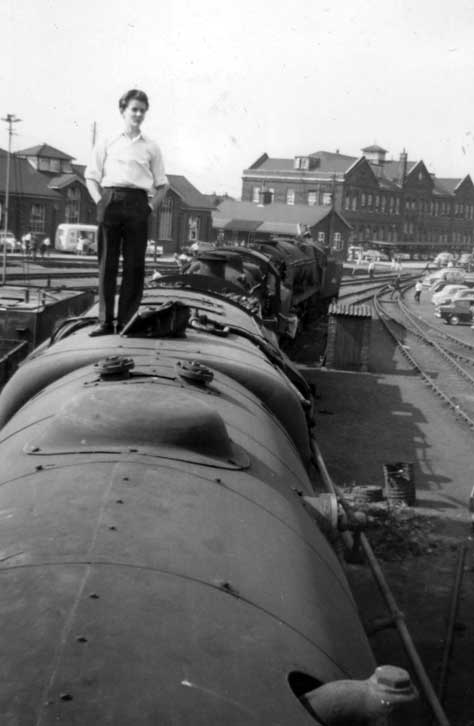
 I bought a student’s Southern rail pass for a week for £2·50 (actually £2 and 10
shillings as Britain hadn’t yet decimalized the currency) and planned to travel
between Exeter, Weymouth and Dover. I had not realized that express passenger
steam was about to end so found myself each day between Waterloo and Weymouth.
There was no discernible pattern to the steam workings but I managed at least
one trip a day behind a Bulleid pacific. One memorable trip was the
I bought a student’s Southern rail pass for a week for £2·50 (actually £2 and 10
shillings as Britain hadn’t yet decimalized the currency) and planned to travel
between Exeter, Weymouth and Dover. I had not realized that express passenger
steam was about to end so found myself each day between Waterloo and Weymouth.
There was no discernible pattern to the steam workings but I managed at least
one trip a day behind a Bulleid pacific. One memorable trip was the
 You asked me about the miniature railway. This was about 12 inch gauge and
serious stuff. It ran a timetable service to Blackwater (9d return) that was
used as a good place for housewives to shop as there was almost nothing in North
Farnborough.
You asked me about the miniature railway. This was about 12 inch gauge and
serious stuff. It ran a timetable service to Blackwater (9d return) that was
used as a good place for housewives to shop as there was almost nothing in North
Farnborough.